Blog
Lab Leadership 4.0: Why “REMOTE” Means Freedom, Not Loss of Control — and What a Modern Cloud LIMS Must Deliver
If you’re not on-site, you can’t lead.” This mindset is costing labs the very talent they can no longer afford to lose. A cloud-based LIMS (or cloud-ready LIMS) enables approvals, data analysis, and compliance documentation from anywhere—securely, audit-ready, and fully compliant. Lab leadership in 2026 doesn’t require a lab bench. It requires access.
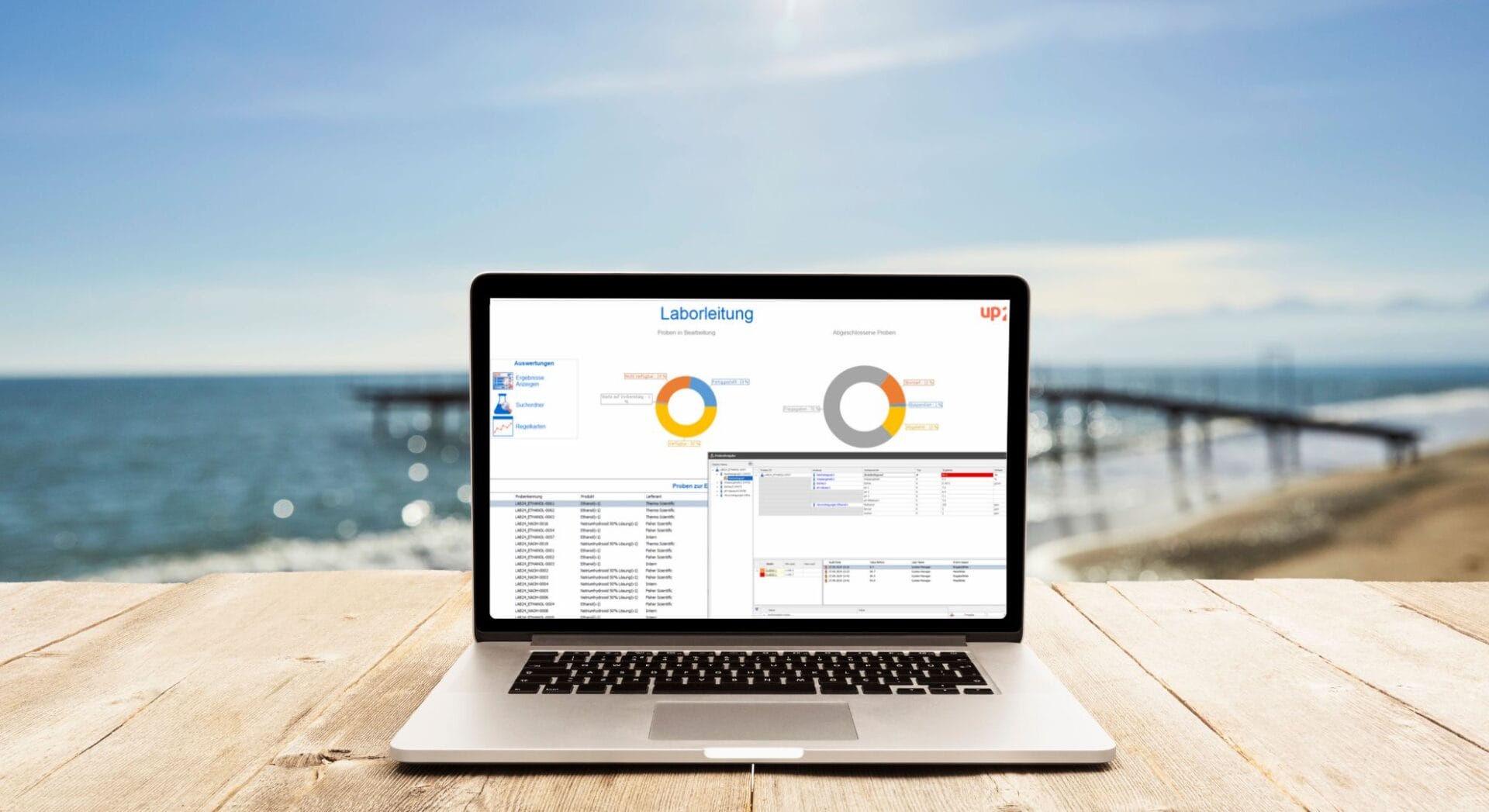
Some days don’t start the way you planned.
Your child is home, even though you’re supposed to be at work—and your to-do list didn’t get the memo about daycare being closed. You’re in a lab leadership role. Approvals, data review, documentation, internal coordination—none of that requires a physical lab stool. It requires access. And a system that works with you.
The issue isn’t your physical presence. It’s a LIMS problem. In a world transitioning to Lab 4.0, your workplace shouldn’t be tied to a specific location. This is where modern labs separate themselves from those still catching up.
The Reality in Labs: Presence Culture Meets Talent Shortage
Labs have traditionally been on-site workplaces—and for much of the work, that remains true. Sample collection, instrument operation, and manual analyses cannot be done remotely. But a significant portion of daily lab work is administrative: approving results, reviewing data, generating reports, tracking orders, and maintaining quality documentation. With the right system, you can do all of this from anywhere.
This isn’t about convenience. It’s strategic.
While labs cling to rigid on-site models, the talent shortage is accelerating across the industry. A study by the German Economic Institute (IW Cologne) found that in 2023 alone, around 176,000 qualified professionals were missing in pharma-related roles. Out of roughly 460,000 open positions, nearly half could not be filled. The 2025 Chemical Industry Skills Report adds that over 71,000 positions remained unfilled in 2024 alone. In high-demand regions like Rhine-Main or Bavaria’s biotech clusters, more than 80% of roles in some job profiles remain vacant.
The competition for qualified lab personnel is no longer regional. And anyone trying to win it with fruit baskets and mandatory on-site presence will lose.
What Talent Actually Wants Today
In a representative Indeed survey, three out of four respondents said flexible working hours or locations are important. Yet only 30% actually have access to such flexibility. That gap isn’t inevitable—it’s a choice. And for labs aiming to attract and retain talent, it’s becoming increasingly costly.
The ifo Institute puts it clearly: removing geographic constraints significantly improves matching between job seekers and employers. In practical terms, labs that enable remote work don’t just recruit locally—they recruit nationwide.
This is especially relevant for parents and caregivers—a group well represented in scientific and technical roles but often constrained by rigid structures. When people with caregiving responsibilities realize their work model offers no flexibility, they reduce hours or leave entirely. Both outcomes are losses that labs cannot afford.
The Hans Böckler Foundation explicitly warns: organizations that fail to offer flexible models risk permanently losing employees with caregiving responsibilities—directly worsening the talent shortage.
Remote in the Lab: What Works—and Why LIMS Is the Key
No one claims that all lab work can be done remotely. But the share that can be done remotely is larger than many labs assume.
What must remain on-site: sample collection and preparation, instrument operation, physical quality checks, and shift handovers requiring presence.
What can be done remotely—if the system allows:
- Result approvals and batch releases
- Data analysis and plausibility checks
- Documentation and SOP management
- Order management and sample tracking
- Internal coordination, reporting, and trend analysis
- Communication with clients and regulators
- Training materials, validation documentation, and change control processes
The key is a LIMS that isn’t tied to a lab workstation—but acts as a true decision hub, independent of location.
The Cloud as a Breakthrough
On-premises systems create dependencies: local infrastructure, VPN setups, fixed workstations. A cloud-based or cloud-ready LIMS eliminates these constraints—offering global browser or tablet access, centralized data as a single source of truth, scalability without IT overhead, and seamless integration with existing systems and instruments.
McKinsey notes that cloud-based lab approaches significantly reduce implementation time for new processes while enabling location-independent collaboration. Deloitte and AWS similarly highlight in “The Lab of the Future” that cloud and AI together fundamentally reshape lab operations—moving away from fixed terminals toward agile, data-driven workflows.
The result: decisions happen where they are needed—not where the server is located.
What a Modern LIMS Must Deliver for Remote Work
Not every LIMS is designed for remote access. Legacy on-prem systems are often tied to local infrastructure, require heavy IT support, or lack full web functionality. This is not a technical limitation—it’s a design decision made before remote work became relevant.
A future-ready LIMS must include:
- Full web access—no compromises
External access must not be a stripped-down portal. Approvals, analytics, sample status, and document management must be fully available remotely—on par with on-site work. - Mobile-first design
Tablet-optimized interfaces enable true remote control. Reports can be approved on the go, dashboards provide real-time visibility into KPIs and sample status, and smart notifications allow immediate action.
Example: A lab manager receives an alert about a threshold breach, reviews the data on a tablet, and approves corrective actions within minutes—not hours. That’s not control through presence. That’s control through transparency. - Role-based access control (RBAC)
Granular permissions define who can approve, view, or edit specific data. This protects data integrity and is essential for GxP compliance, ensuring every action is traceable to an individual. - Complete audit trail
In regulated environments—pharma, medical devices, food testing, ISO 17025 labs—every action must be traceable. A remote-ready LIMS logs every access, change, and approval with timestamps, user IDs, and context. - Encryption and secure authentication
Remote access increases risk—if poorly implemented. Modern systems use end-to-end encryption, multi-factor authentication, and integrate with identity management systems. - System integration
A LIMS that works remotely but doesn’t integrate with ERP, QMS, or instruments creates inefficiencies. End-to-end digital workflows are essential to avoid workarounds and maintain data integrity.
Regulation: Remote Work Is Not a Gray Area
A common concern is whether remote approvals are legally valid. The answer is yes—under the right conditions.
FDA 21 CFR Part 11 and EU GMP Annex 11 both allow electronic signatures and remote approvals if:
- The system is validated
- Audit trails are complete
- User authentication is secure (e.g., MFA)
- Access permissions are documented and regularly reviewed
ISO 17025 also does not require physical presence for administrative tasks—it requires competence, accountability, and traceability.
In fact, a modern LIMS improves compliance by making processes more transparent and auditable. The real question is not “Is it allowed?” but “Can your system prove it?”
The Lab as a Data Factory
A cloud-based LIMS is more than an administrative tool—it is the foundation for data-driven operations. Studies show productivity gains of 30–40% when lab processes are fully digitized. A modular LIMS acts as the organization’s “technical memory,” preserving knowledge, accelerating information flow, and reducing dependency on individuals.
In this context, remote work is not a risk—it signals digital maturity.
More Than Efficiency: Remote Work as Employer Branding
The competition for talent in the lab industry will intensify. And today’s professionals don’t choose employers based on salary alone—they evaluate how organizations handle real life. Parental leave, caregiving responsibilities, chronic conditions—these are not exceptions. They are reality. Labs that account for this structurally are not being generous—they are being strategic.
A 2025 ZEW study shows that companies eliminating remote work risk falling behind in the talent market. The return-to-office debate is often driven more by habit than by data.
Labs that understand this gain a real competitive advantage.
Conclusion: Insight Comes from Transparency, Not Presence
No one expects labs to operate fully remotely. But the “if you’re not here, you’re not working” model is outdated. It costs talent, limits leadership, and makes labs less attractive in a competitive market.
Lab leadership in 2026 means being able to act anytime, from anywhere. A modern LIMS makes this possible: secure data, clear processes, full transparency. It enables compliant remote work, location-independent leadership, and positions the lab as a place people want to work.
References
Alipour, J.-V. (2023). Wie Homeoffice die Produktivität der Beschäftigten verbessert [Gastbeitrag]. ifo Institut. URL: https://www.ifo.de/medienbeitrag/2023-12-19/wie-homeoffice-die-produktivitaet-der-beschaeftigten-verbessert.
AmpleLogic (2026). Warum ist das cloudbasierte LIMS-System die ultimative Lösung für moderne Labore? URL: https://www.amplelogic.com/de/blog/cloud-based-lims-system-for-modern-labs.
analytica (2026). Labor 4.0 – der Weg in das smarte Labor der Zukunft [Trendbericht]. Messe München. URL: https://analytica.de/de/muenchen/presse/trendberichte/labor-der-zukunft/.
Deloitte (2026). GxP Advisory in Life Sciences & Healthcare. URL: https://www.deloitte.com/de/de/Industries/life-sciences-health-care/gxp-advisory-life-sciences-healthcare.html.
Deloitte & AWS (2026). The Lab of the Future: How AI and the cloud are transforming the science of discovery. URL: https://www.deloitte.com/us/en/what-we-do/capabilities/converge/articles/laboratory-solutions-genai-aws-deloitte.html.
European Commission (2011). EudraLex – The rules governing medicinal products in the European Union: Vol. 4. Good manufacturing practice – Annex 11: Computerized systems. https://health.ec.europa.eu/system/files/2016-11/annex11_01-2011_en_0.pdf.
Hays (2026). Hays Fachkräfte-Index Life Sciences. URL: https://www.hays.de/personaldienstleistung-aktuell/fachkraefte-index-life-sciences.
Indeed (2025). Indeed-Umfrage: Mehr Homeoffice als eigentlich erlaubt [Befragung von 1.000 Arbeitnehmenden; Berichterstattung]. WirtschaftsWoche. https://www.wiwo.de/erfolg/beruf/arbeiten-von-zu-hause-indeed-umfrage-mehr-home-office-als-eigentlich-erlaubt/100136448.html.
International Organization for Standardization (2017). General requirements for the competence of testing and calibration laboratories (ISO/IEC 17025:2017). https://www.iso.org/standard/66912.html.
Kirchhoff, J., Malin, L., Schumacher, S., & Werner, D. (2024). Fachkräftemangel: Hemmschuh für den Pharmastandort Deutschland [Gutachten im Auftrag des vfa]. Institut der deutschen Wirtschaft. https://www.iwkoeln.de/studien/jasmina-kirchhoff-lydia-malin-dirk-werner-hemmschuh-fuer-den-pharmastandort-deutschland.html.
Lott, Y. (2020). Work-Life-Balance im Homeoffice: Was kann der Betrieb tun? (WSI Report Nr. 54). Wirtschafts- und Sozialwissenschaftliches Institut (WSI) der Hans-Böckler-Stiftung. https://www.wsi.de/de/faust-detail.htm?sync_id=8828.
McKinsey & Company. (2023). From bench to bedside: Transforming R&D labs through automation. https://www.mckinsey.com/industries/life-sciences/our-insights/from-bench-to-bedside-transforming-r-and-d-labs-through-automation.
Tiedemann, J., Kunath, G., Risius, P., Orange, F., & Werner, D. (2025). Fachkräftecheck Chemie (KOFA-Studie Nr. 2/2025). Institut der deutschen Wirtschaft / Kompetenzzentrum Fachkräftesicherung (KOFA). https://www.kofa.de/daten-und-fakten/studien/fachkraeftecheck-chemie-2025/.
U.S. Food and Drug Administration (2026). Electronic records; electronic signatures (21 C.F.R. Part 11). Electronic Code of Federal Regulations. Abgerufen am 25. Juni 2026 von https://www.ecfr.gov/current/title-21/chapter-I/subchapter-A/part-11.
ZEW – Leibniz-Zentrum für Europäische Wirtschaftsforschung (2025). Wenige Unternehmen planen die Abkehr vom Homeoffice [Pressemitteilung]. https://www.zew.de/presse/pressearchiv/wenige-unternehmen-planen-abkehr-vom-homeoffice.