LIMS: The Underestimated Digitization Lever in Quality Control
Real-Time Data is Key to Quality Assurance and Better Decisions
In the age of Industry 4.0 and smart manufacturing, many companies focus on optimizing production lines, modern machinery, and production networking systems. However, one area is often ignored: the laboratory information and management system (LIMS) in quality control. Yet a LIMS can be the key to more efficient processes, better data integrity, and higher product quality. This article shows why small and medium-sized manufacturing companies and laboratories should no longer regard a LIMS as a mere “nice-to-have”, but as a strategic tool for product success.
Quality Control without LIMS: Challenges and Risks
In a typical manufacturing company, every product undergoes several quality checks – from incoming goods inspection to intermediate checks and final release. However, without a modern LIMS, these processes often lead to inefficient and error-prone workflows:
- Manual sample planning and labeling: Time-consuming and prone to mix-ups.
- Handwritten documentation of measured values: High error rate when recording data manually.
- Time-consuming transfer to Excel spreadsheets: Media disruptions slow the process and increase the likelihood of transfer errors if done manually.
- Poor communication between departments: Delays in approval processes and troubleshooting or error detection.
- Time-consuming test certificate creation: Regular data collection is a major resource drain.
The result: rising costs, quality risks, and greater pressure on employees.
Step 1: Start Laboratory Automation with LIMS
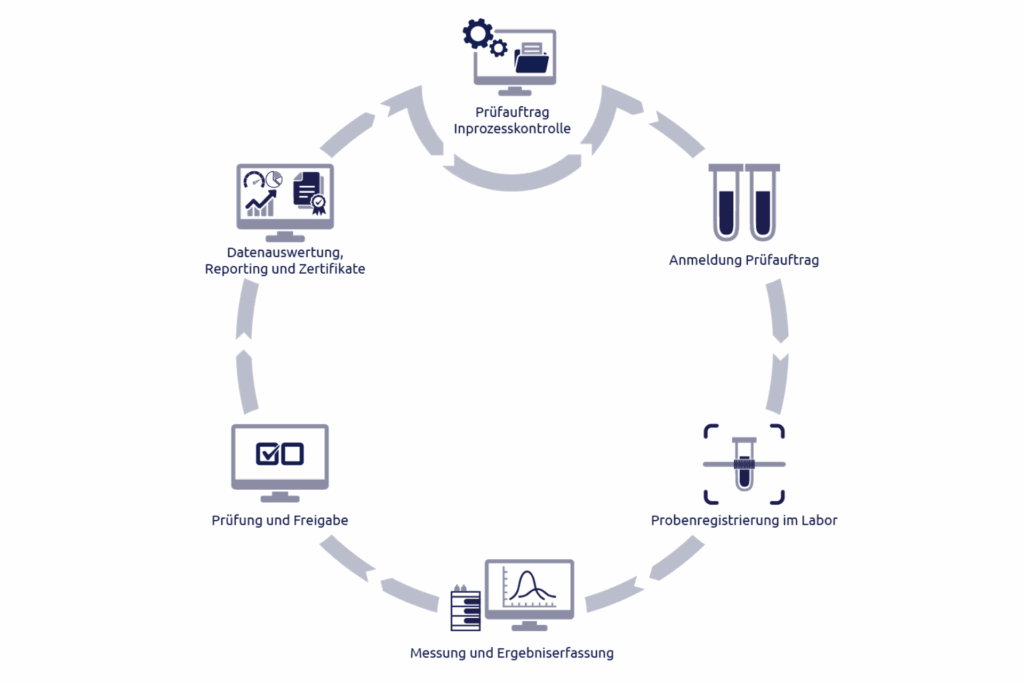
A modern laboratory information management system forms the foundation for digitalizing quality control. It automates manual steps, follows clearly defined workflows, and creates greater efficiency and transparency.
Typical Functions of a LIMS:
- Automated sample registration: unique IDs prevent mix-ups.
- Direct data transfer from analyzers: Measured values flow seamlessly into the system.
- Digital workflows for sample management: transparency from capture to release.
- Rule-based approval processes: Faster decisions thanks to standardized criteria.
- Automatic creation of test reports: Available in seconds instead of hours.
This automation not only reduces time but also significantly improves data quality and integrity.
Step 2: System Integration – LIMS as a Multiplier
The true added value of a LIMS becomes apparent only through integration into the company’s existing IT. Connected systems ensure that quality control does not remain isolated, but that all departments benefit from automation.
- ERP Systems (Enterprise Resource Planning)
- Automatic import of test orders.
- Directly feed approvals into the system.
- Synchronization of material status and test reports.
- MES Systems (Manufacturing Execution Systems)
- Real-time process adjustments based on QA data.
- Predictive quality through continuous data analysis.
- Immediate reaction to limit value violations.
- Supplier Portals
- Digital exchange of test certificates.
- Evaluation of supplier quality based on real data.
- Reduced paper archives and manual data entry.
Seamless networking enables companies to react faster and more precisely to quality problems.
Step 3: Strengthen Cross-Departmental Collaboration
A modern LIMS creates the basis for genuine interdisciplinary collaboration:
- Production receives real-time feedback on quality parameters and can adjust processes immediately.
- Development accesses historical quality data to improve products.
- Purchasing benefits from objective supplier evaluations.
- Management has access to KPIs that support sound decision-making.
This makes quality control a central element of the overall corporate strategy, as company-relevant decisions can be made based on real-time data and cross-divisional insights.
Advantages of a modern LIMS: more than Digitization
Investing in an innovative LIMS is more than just laboratory digitization; it is the key to:
- Higher product quality: Consistent data integrity and more precise analyses.
- Faster throughput times: Automated processes speed up inspections.
- Improved compliance: Seamless documentation and audit trails.
- More informed decisions: Real-time data for optimized processes.
The true added value of a networked LIMS system is especially evident in product-related decisions. Real-time data lets companies adjust production parameters before quality deviations occur. At the same time, companies can monitor material properties in real time and automatically readjust processes, ensuring consistently high product quality.
The release of batches also benefits considerably: what used to require manual checks and a lot of time can now be completed within minutes thanks to comprehensive data analysis. In addition, a LIMS provides valuable insights into historical data that can be used to optimize product formulations more precisely.
In addition, a networked LIMS enables the development of predictive quality models. Such models help identify potential problems early and enable appropriate action before they lead to production downtime or quality defects. Companies can make well-founded decisions such as “make or buy” based on objective quality indicators, giving them more security and flexibility. Companies can also evaluate supplier quality in real time and incorporate this information directly into procurement strategy.
Integrating LIMS into a company’s IT landscape creates the basis for a data-driven quality strategy. Decision-makers always have access to current quality trends, can analyze correlations between process parameters and product quality, and compare production lines in real time. A LIMS also provides important KPIs that effectively support continuous improvement processes.
Conclusion: LIMS as Key to a Data-Driven Future
Companies that see a LIMS as a strategic tool will secure a long-term competitive advantage. Digitalizing quality control is the starting point for a data-driven transformation that goes far beyond the laboratory.
Invest in the future of your quality control – with a modern LIMS that optimizes your processes and puts your company on the road to success.