Blog
Excel Silos in Quality Control: Why SME Laboratories Must Switch to End-to-End Digitalization Now
Hybrid systems built on paper and Excel spreadsheets remain an everyday reality in many small- and mid-sized labs—and in a regulated environment, they quickly become a compliance risk. This article explains why Excel silos in QC put data integrity at risk under ALCOA+, EU Annex 11, and 21 CFR Part 11 — and how a professional LIMS like up2LIMS systematically closes the gap between paper-based processes and enterprise software.
Introduction: Digital Maturity in the DACH Region
Digitalization in the lab world is often held up as the goal everyone is working toward — but in the DACH region, reality lags far behind ambition. Cross-industry surveys such as the QI-Fokus study 2024 illustrate the general level of maturity: internationally, only 18 percent of the organizations surveyed have fully embedded digitalization in their structures. The study does not look exclusively at laboratories, but it highlights a problem that is especially clear in QC and pharmaceutical labs: results are often already transmitted digitally, while internal core processes remain fragmented and paper- or Excel-based.
up to data is an expert in laboratory digitization and offers tailored digital laboratory solutions through up2LIMS—we know that digitization is not an end in itself, but a strategic lever for future viability. As the QI-Digital initiative and the Digital LabHub put it, digitalization is a team sport (“Digitalisierung ist Mannschaftssport”). It is no longer about isolated software installations, but about building a connected, standardized ecosystem in which data, instruments, and people work together seamlessly — securing both cost-effectiveness and confidence in test results. The perspective here is the lab looking outward at the wider organization.
The Excel Trap: Why “Light-Touch Digitalization” Is Critical in Regulated QC
“That’s how we’ve always done it.” You still hear this sentence in many small and mid-sized labs. This is why quality management systems remain paper-based or rely on hybrid setups that combine paper and Excel documents. In a regulated environment, though, that attitude is a serious problem. From a compliance perspective, these hybrid systems are a critical bottleneck. Analyses by experts such as Susanne Kolb (DGQ) conclude that standalone solutions of this kind no longer reflect the current state of the art.
The extreme dependence on individual people is particularly critical. When complex validations or evaluations hang on single, locally maintained Excel silos, the absence of the one person responsible becomes a major management risk. In that scenario, the impact on data integrity and on the ability to reconstruct events is often comparable to a full operational standstill.
Do any of these “daily pains” sound familiar?
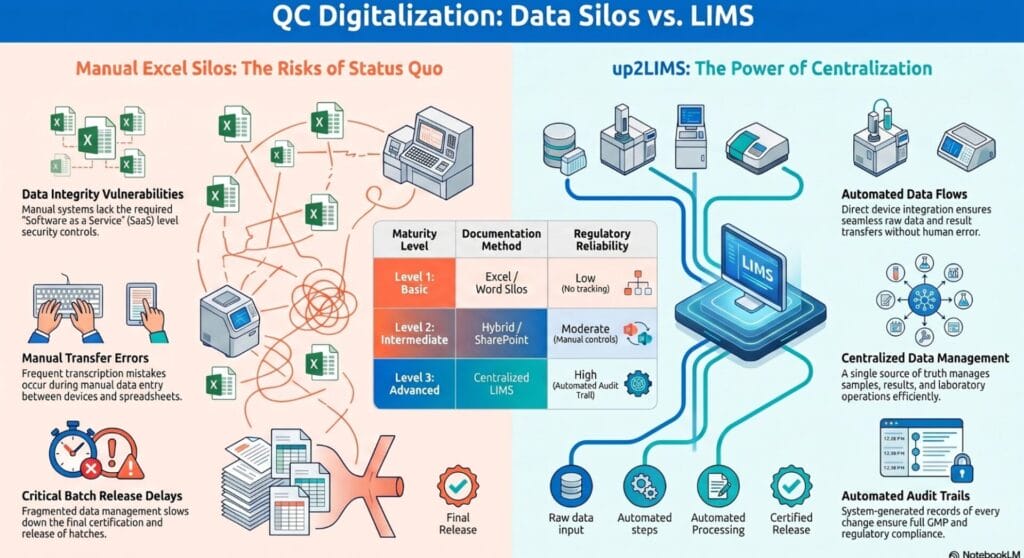
- No computer-generated audit trails: Records can be changed after the fact without documenting the reason for the change, as required by Annex 11, Clause 9.
- High compliance risk: Manually transferring raw instrument data introduces transcription errors and compromises data integrity.
- Broken media chains: Switching between paper documentation and digital storage makes efficient process control difficult.
- Insufficient individual attributability: There is no complete record of who — or what — triggered a given event in the system (a violation of both Annex 11 and FDA 21 CFR Part 11).
- Higher audit effort: Painstaking searches through unstructured data extend inspections and increase the likelihood of findings.
Infographic 1: QC Digitalization: Data Silos versus LIMS
Compliance Risks: 21 CFR Part 11 and EU Annex 11 in Focus
For labs in a regulated (GxP) environment, adherence to the ALCOA+ principles is the basic condition for having their data accepted by authorities such as the FDA or the European Commission. Excel silos can meet these requirements only with considerable effort, if at all—that is inherent to how they work. Data integrity requirements, in particular, cannot be met in unsecured spreadsheets.
- Attributable
- Legible
- Contemporaneous
- Original
- Accurate
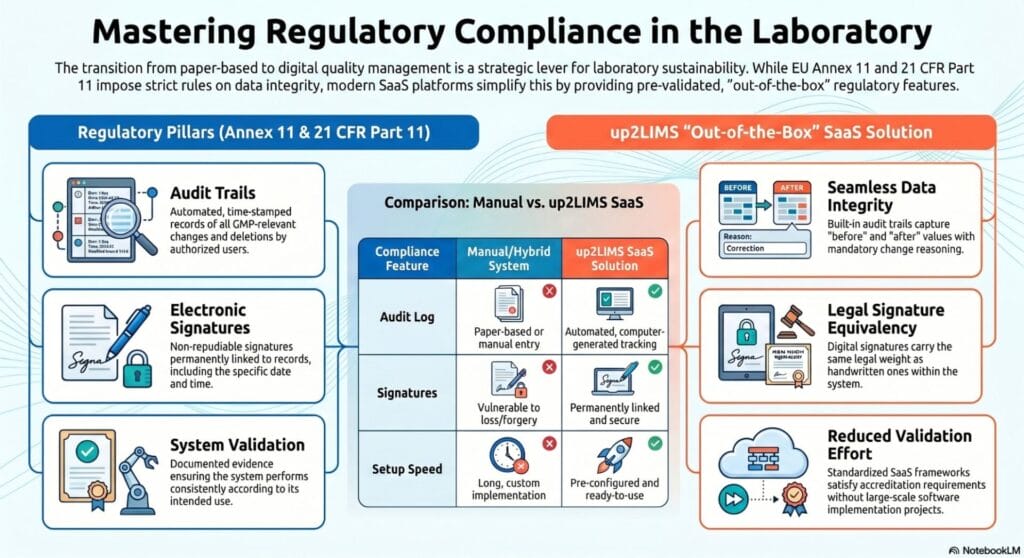
The table below shows how concrete these risks are — and how a LIMS (up2LIMS, for example) addresses them systematically:
| Requirement (Annex 11 / Part 11) | Risk When Using Excel | LIMS Solution (e.g., up2LIMS) |
| Audit Trail (Annex 11, Clause 9) | Changes can occur without a documented reason; data can be overwritten. | Automatic, time-stamped logging of every change, including a mandatory reason for change. |
| Data Integrity (ALCOA+) | Raw data can be deleted or modified without anyone noticing; events cannot be reliably reconstructed. | System-level locks make records tamper-proof; complete history is retained. |
| Electronic Signature (Part 11, Clause C2) | No authenticity; names can simply be typed into a spreadsheet. | Tamper-proof link between user ID and password, permanently bound to the record. |
| Batch Release by the Authorized Person (FDA) | Manual review causes delays and carries a high risk of undetected deviations. | Real-time audit analysis lets the Qualified Person (QP) release batches with confidence, in line with Annex 11, Clause 15. |
Infographic 2: Mastering Regulatory Compliance: Navigating Annex 11 and 21 CFR Part 11
Strategic Advantages: Beyond Simply Avoiding Errors
Implementing a professional LIMS is far more than a compliance exercise. In line with WHO recommendations and the findings in NIST SP 800-12 (Chapter 18.1.2/4), the strategic benefits are substantial:
- Automated problem analysis: Trend analysis not only surfaces deviations faster, but it also allows events to be reconstructed precisely. That drives the rate of out-of-specification (OOS) results down sharply.
- Higher data quality and reproducibility: Following WHO guidance, a LIMS ensures that data remains legible and retrievable over the long term, making it safer and more efficient to respond to customer inquiries and audits.
- Fast reporting: Standardized CoA/CoC reports (certificate of analysis/certificate of conformance) can be generated at the push of a button — accelerating batch release and eliminating manual transcription errors.
- Scalable economics: A digital ecosystem enables you to handle a growing sample load without a proportional increase in headcount. Automated reports cut administrative turnaround times to a minimum.
A LIMS That Truly Fits: up2LIMS as the “Perfect Fit”
For small- and mid-sized companies (11 to 500 employees), a LIMS must be efficient, scalable, and lean. up2LIMS is built cloud-ready to help close the gap between complex enterprise systems and insecure Excel silos. It’s interoperable and can provide interfaces to a range of enterprise systems and instruments. A risk-based approach aligned with GAMP 5 keeps validation effort low.
The arguments that matter most when you make the switch:
- 30 years of expertise: We bring three decades of experience as a LIMS implementer in regulated environments — and as a Thermo Scientific™ partner — directly into your implementation.
- GxP compliance out of the box: up2LIMS meets the strict requirements of accredited labs (ISO/IEC 17025, for example) in its standard configuration, so it is ready for accreditation from day one.
- Seamless migration with no broken media chains: We move your legacy data into a digital structure (the LIMS database) so that nothing is lost along the way.
- On-premises or cloud: The cloud option enables rapid implementation with minimal internal IT overhead. The proven on-premises deployment remains an option.
Conclusion & Outlook: Laboratory 4.0 Starts Today
Moving from error-prone Excel silos to a validated LIMS like up2LIMS is not optional. In a regulated market, it is a basic requirement to stay in business. And it is not a purely technical project — it is an investment in your company’s competitiveness and long-term viability.
Only labs that pursue a connected, interoperable ecosystem can meet data integrity and efficiency requirements over the long run. The vision of a lab where data flows seamlessly and compliance is assured automatically is already within reach for small and mid-sized companies with up2LIMS.
References
Bundesanstalt für Materialforschung und -prüfung (2025). Digital LabHub. URL: https://www.qi-digital.de/digital-labhub
Bundesanstalt für Materialforschung und -prüfung (2025). Projektgruppe Digitalisierung der Qualitätsinfrastruktur (QI). URL: https://www.ptb.de/cms/ptb/fachabteilungen/abt9/fb-94/qi-digital.html
Deutsche Gesellschaft für Qualität (2024). Digital Transformation in Accredited Laboratories. URL: https://www.dgq.de/fachbeitraege/die-digitale-transformation-in-akkreditierten-laboren-aktueller-stand-herausforderungen-und-chancen-teil-1
Dr. Klinkner & Partner GmbH (2026). LIMS: Category Fundamentals. URL: https://www.lims.de/post-category/grundlagen/
European Commission (2011). EudraLex Volume 4, Annex 11: Computerized Systems. URL: https://health.ec.europa.eu/system/files/2016-11/annex11_01-2011_en_0.pdf
Food and Drug Administration (2024). Guidance for Industry: Part 11, Electronic Records; Electronic Signatures — Scope and Application. URL: https://www.fda.gov/media/75414/download
National Center for Biotechnology Information / World Health Organization (2017). LQMS 17-4: Computerized laboratory information systems. URL: https://extranet.who.int/lqsi/sites/default/files/attachedfiles/LQMS%2017-4%20Computerized%20LIS.pdf
National Institute of Standards and Technology (2014). Chapter 18: Audit Trails. URL: https://csrc.nist.rip/publications/nistpubs/800-12/800-12-html/chapter18.html